

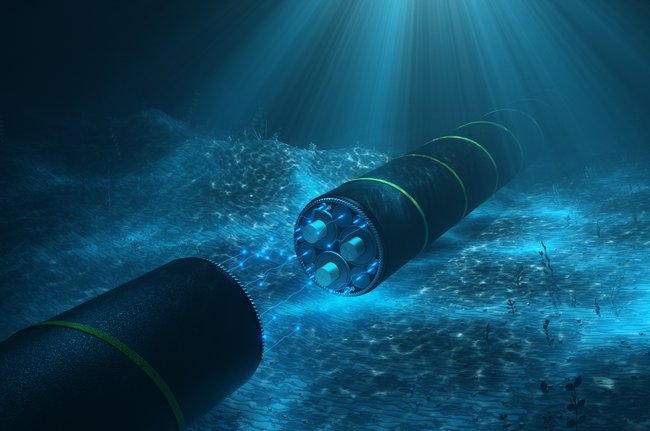
When you send an email, where do you think it goes? Most people would say it travels up into the clouds to bounce between satellites before landing at its destination just seconds later.
But in reality up to 99 per cent of all data sent over the internet passes through a network of 16 cables that lay along the sea floor to connect Australians with each other and the rest of the world.
Each fibre-optic cable has the ability to transmit more than 20 terabits of data — equivalent to downloading the Russell Crowe-led movie Master And Commander about 2500 times — every second.
Know the news with the 7NEWS app: Download today
However, the reliance on these cables has led to major concerns surrounding the possibility they could become the target of attacks from international powers.
Former ADF officer turned UNSW senior lecturer Andrew Maher told 7NEWS.com.au important infrastructure is often the first to be targeted when conflict erupts.
In the scenario of Australia being involved in a conflict, undersea cables would most likely be part of a “broader campaign of sabotage”.
“I think that’s important because any one incident on its own generally doesn’t have a huge impact but, in the aggregate, we do start to see a broader border impact,” Maher said.
He added that if all of the cables were somehow severed, the impact on Australia would be widespread and on “two levels”.
“The first one is just basic panic,” Maher said, adding: “if you can’t use your credit card to pay for your coffee in the morning … that’s that’s inherently disruptive.”
That could lead to “panic that might well then ensue if you feel like there might be a prolonged outage, so I think there’s a psychological impact that needs to be anticipated and considered here”.

The second impact would be how hard it would be to send vital information overseas over satellites.
Monash University associate professor of electrical and computer systems engineering Bill Corcoran said the difference between fibre-optic undersea cables and satellites orbiting Earth was drastic.
Corcoran told 7NEWS.com.au even modern satellites were only able to transmit “a few gigabits per second” — or downloading Master And Commander once every second.
“In an absolute disaster scenario where all of these cables would be suddenly disconnected, I can’t imagine how that could occur, but we would be cut off from communicating with the outside world at the volume that we do,” he said.
“We’d have other backups … there are things like satellite communications but that’d be an issue.”
Even if a number of cables are damaged, each individual cable carries enough data for Australia to be reasonably unscathed.
“Our peak national usage of all of the data around the NBN internally within Australia can be carried in two optical fibres that might connect us to the outside world,” he said.

“So we only really need two, but we’d like our data to go through where we want it to go.
“The key part about having many cables connected to our nation is redundancy.
“It’s good that, if we have one of these cables having a fault, then we have backup options kicking around.”
Latest damage to cables around the globe
The alarm was last raised by officials in early August, after two of the five cables which connect Perth with Australia’s east coast, north coast and Singapore were damaged.
Both cables were damaged in suspicious circumstances within a Submarine Cable Protection Zone off the city, according to SUBCO, which owns several of Australia’s key optical fibre links.
SUBCO founder Bevan Slattery at the time referred to “suspicious” or “coincidental activity from a vessel near the location and timing of the shunts occurring”.
“This is a concerning development,” Slattery said.
“Partially because submarine cables are the digital lifeblood of our nation, but also because this could very well turn out to be the second such incidence in a federally declared cable protection zone.”
Australian Federal Police confirmed it had received a report about the incident and further comment “will be made at an appropriate time”.
Defence Minister Richard Marles even described the seabed as “becoming a battlefield” while addressing this year’s Shangri-La Dialogue in Singapore.
“We have been slow, collectively slow, to recognise (submarine cables) as the strategic targets they have become,” he said in May.
While the source of the damage is yet to be confirmed, Corcoran said there are a number of reasons a cable could be severed or damaged.
“Generally what’s happening is you’ve got somebody who’s made a mistake and they’re dragging an anchor or they’re put down a trawler net where they shouldn’t have and this interacts with the cable,” he said, also noting that subsea earthquakes can also cause a cable to be damaged.

But further advancements in technology and preventative measures, such as exclusion zones, would make the cables less likely to be completely damaged and severely limiting internet access.
Corcoran said that companies have already shown the ability to adapt when sharks and other marine life began biting the cables when they were first being introduced around the turn of the millennium.
News reports of marine life damaging deep sea cables stretch back to the 1980s, acknowledged in a UN report from 2009.
“Fish, including sharks, have a long history of biting cables as identified from teeth embedded in cable sheathings,” the report reads.
“Barracuda, shallow and deep-water sharks and others have been identified as causes of cable failure.
“Bites tend to penetrate the cable insulation, allowing the power conductor to ground with seawater.”
Sharks seem to be particularly attracted to the cables due to their sensitivity to electric currents which they use to hunt.
One video of a shark gnawing at a cable before sheepishly gliding away has been watched millions of times online.
But Corcoran said that engineers learnt how to limit the damage of sea life and the issue has been mostly non-existent for more than a decade.


