

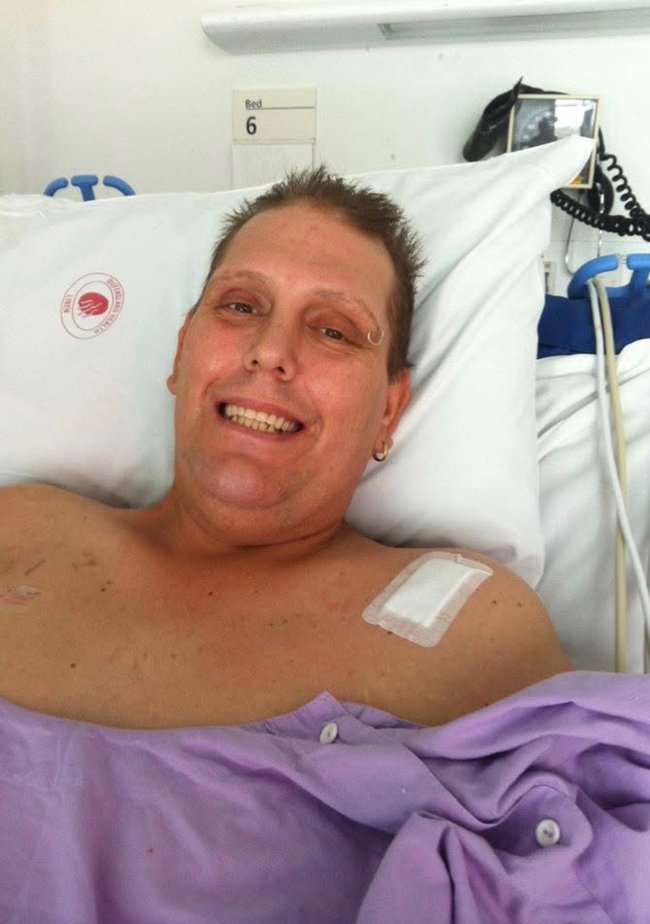
Jon “Big Jon” Twartz knows the staff at The Prince Charles Hospital so well he jokes he is a “professional patient”.
He has walked almost every ward, formed lasting bonds with those who have cared for him and returned so often the Brisbane hospital has become his second home.
There is just one department he hopes never to visit.
Know the news with the 7NEWS app: Download today
“I’ve had a go at each ward except cardio, and I’m not going there,” he says with a laugh.
Behind the humour lies a medical journey beginning with a blister, nearly costing him his life and leading to more than 400 hospital admissions.

In December 2011, Jon was in his late 30s, working at a petrol station and raising two young children with his partner.
He was also trying to lose weight, going to the gym three nights a week and doing what he thought was right to stay healthy.
Then he developed a blister on his left big toe.
“I went to work feeling really sick and I ended up going home early and I went to the doctor’s surgery and he said I was in the third stage of ‘septic shock’,” Jon recalls.

It would be almost a month before he understood just how close he had come to dying.

By the time he woke in intensive care at the intensive care unit, the infection had triggered a medical crisis changing the course of his life.
“I woke up about three weeks later in ICU here in the Prince Charles Hospital trying to pull the life support out of my mouth,” he says.
Sepsis is a life-threatening condition that occurs when the body’s extreme response to an infection, which can start anywhere from the skin to the lungs, damages its own tissues and organs.
Jon’s condition had deteriorated at terrifying speed.

He remembers his temperature reaching 42 degrees as he convulsed in his hospital bed, prompting a medical emergency call.
“My body was shutting down,” Jon says.
“So it happens that quick. Like, I was sitting at home eating an hour prior to that, and then an hour later I’m dying on a bed.”
The experience left him with a stark understanding of how quickly sepsis can turn a seemingly ordinary day into a fight for survival.
His family, meanwhile, was confronted with the possibility of losing him.
On Christmas Eve, doctors called his partner at 5pm to tell her they were preparing to amputate his right arm.
The infection and its complications ultimately cost Jon a leg, while he also developed chronic inflammatory demyelinating polyneuropathy, or CIDP, a neurological condition affecting the peripheral nerves. Thankfully doctors were able to save his arm.
“Since then I’ve had sepsis over 25 times, cellulitis over 22 times, and I’ve been in this hospital 427 times as of today,” he says.
“I have used the system a lot, but it has saved my life.”

For Jon, the number of hospital visits is more than a statistic.
It represents years of infections, treatment, uncertainty and the people who have helped him through each setback.
He still requires plasma infusions at The Prince Charles Hospital every fortnight, receiving two bottles each time, as he has done for the past 15 years.
“Hence that’s why this is my second home. I come here all the time,” he says.
“Whether it’s an infection or for my infusions.”
nA hospital where everyone knows his name
For someone who has spent so much of his life in hospital, Jon says the relationships he has built with staff have become an important part of his experience.
Despite being home to Queensland’s second-largest emergency department, with more than 420,000 patients coming through its doors each year, Jon says patients are known as individuals rather than numbers.
“Everybody knows your name, everybody knows you,” he says.
“It’s very friendly, and it’s very personal care.”
He has developed friendships with many of the healthcare professionals who have treated him over the years.
“The staff here are just incredible,” he says.
“I’m friends with a lot of them. I’m a professional patient.”

Jon is particularly grateful to the doctor whose intervention helped turn his initial medical crisis around.
“I was very lucky that day a doctor was passing by and visiting another patient in the hospital and he goes, ‘You’ve gotta start looking after that patient for sepsis’,” Jon says.
“And they did, and that’s when a change started.”
After more than 25 bouts of sepsis, Jon knows how quickly the condition can become life-threatening.
“I’m lucky … when I say I’m lucky, I know the signs because I’ve had it so many times,” he says.
But even after everything he has endured, Jon refuses to define his life by what he has lost.
“But I’m still alive, I’m still breathing, I still wake up every day.”

A father’s illness that shaped his children’s lives
Jon’s illness has also impacted the lives of his family, who have spent much of the past 15 years watching him navigate hospital admissions and ongoing treatment.
His children were just five and three when his health crisis began but their experience helped shape their future paths.
His daughter, Jess, was inspired by the care she witnessed Jon receiving.
“She became a registered nurse because of my whole story,” he says.
His son also works in healthcare, in the food and services department at Brighton Rehabilitation Hospital through Queensland Health.
“I am very thankful and blessed for what they are doing, and how I’ve been able to bring them up as a father,” he says.
“Because the last 15 years it’s been living and breathing this hospital.”

Giving patients comfort and dignity
For Jon, giving back is now a way of acknowledging what his family and the hospital community have been through together.
As a Community Ambassador for The Prince Charles Hospital Foundation, Jon is sharing his story ahead of the Foundation’s annual Giving Day on Wednesday, October 28, to encourage others to support patients and medical research.
“If my story can inspire people to donate, fantastic,” he says.
The support patients receive is not always measured in medical procedures or treatments.
For many, an unexpected hospital admission can mean arriving by ambulance without a change of clothes, toiletries or someone who can bring them the things they need.
The hospital foundation’s comfort packs aim to address that simple but important gap.
Chloe Nguyen, the foundation’s Chief Communications and Philanthropy Officer, says the packs provide essentials to patients who may have arrived with nothing.
“These comfort packs provide a spare change of clothes and some of those essential toiletries to give them that comfort and that dignity while they’re in hospital,” she says.
The Laughter Care Program offers another way to make an unfamiliar and often frightening environment feel more human.
Jane Barber, known as Flora, works as a Laughter Care Specialist, bringing moments of humour and connection to patients at The Prince Charles.
She says the impact can be immediate, with patients who have been feeling low or withdrawn responding to her arrival.
“It has quite a big impact because you can see people shift from being quite low energy, maybe a little bit inward, and even just when I turn up at the door … the colour effect, people are taken by surprise,” she says.
Flora’s approach is tailored to each patient and how they are feeling on the day.
“It’s really important to meet them where they’re at,” she says.
Although she brings a collection of tricks and activities, she says the most important part of her work is the connection she establishes with the person in front of her.
“It’s really the engagement with the person and the connection,” she says.
“Some people go, ‘It’s you!’ And that’s lovely to have that effect.”
The foundation is hoping to raise $150,000 through Giving Day to support the Laughter Care Program and comfort packs.

Jon knows first-hand how much hospital care matters, but believes community support is vital to helping patients beyond their medical treatment.
“The government can’t give you everything, can’t give the hospitals everything, and we know that,” he says.
“That’s why we do what we do, that’s why we have the foundation.”
Fifteen years after a blister nearly killed him, Jon still relies on fortnightly infusions and the possibility of further hospital admissions.
But he is determined to turn his experience into something positive, helping others while remaining grateful for the chance to watch his children grow up.
“I’m still alive, I’m still breathing, I still wake up every day.”


